
Andre Boysen Hillestad Completes Historic Six-Gold Season Across Snow and Dryland World Championships
Andre Boysen Hillestad completed a historic 2025 season with six World Championship gold medals—three at Røros snow championships in February and three at Minocqua dryland events in October, dominating both surfaces.

Andre Boysen Hillestad of Hamar Trekkhundklubb has concluded the 2025 IFSS World Championship season with six gold medals—three from snow competitions in February and three from dryland events in October. The Norwegian athlete's performance across both surfaces represents a rare feat in competitive sleddog racing, where specialization typically produces surface-specific champions rather than dual-threat competitors.
Røros Snow Championships: February 2025
Boysen opened his championship campaign at the WM 2025 Røros snow championships with three gold medal performances in 4-dog sled disciplines.
In the Sp4 (4-dog sled) class, Boysen recorded the fastest combined time of 26:13 across two heats. His first heat time of 13:05 established immediate control, followed by a 13:08 second heat that secured the title ahead of Sweden's Elin Björk (26:37) and Slovakia's Andrej Drábik (26:52).
The Sp4MS (4-dog Masstart) format eliminated the heat structure in favor of a single mass-start race. Boysen finished in 12:57, holding off Czech competitor Michal Ženíšek (13:32) and Drábik (13:44) in a race where tactical positioning and dog team acceleration from a standing start determined outcomes.
Boysen's third snow gold came as part of Team Norway 1 in the 3x7.5km relay. Running the second leg, he posted 12:50.3—the fastest individual leg time across all teams—contributing to Norway's winning total of 37:59.0. The Norwegian squad finished 29.6 seconds ahead of Norway II and 44.3 seconds clear of Slovakia.
Minocqua Dryland Championships: October 2025
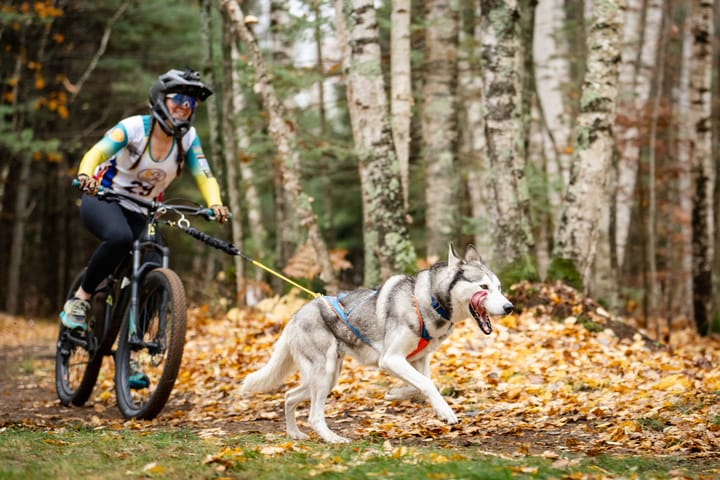
The dryland season presented different technical demands: higher speeds on gravel trails, different equipment mechanics with scooters replacing sleds, and warmer temperatures affecting dog performance management.
In DS1 (1-dog scooter), Boysen recorded 19:25.1 across two 5km heats. His times of 9:43.6 (Heat 1) and 9:41.5 (Heat 2) demonstrated consistency across runs, finishing 25.0 seconds ahead of Sweden's Ulf Rönnberg and 42.5 seconds clear of France's Tony Presles.
The DS2 (2-dog scooter) class produced Boysen's most dominant margin. His combined time of 17:36.6 (8:46.2 + 8:50.4) resulted in a 25.4-second victory over Canada's Camille Sirois and 28.0 seconds over Rönnberg. The 2-dog format represents the premier dryland discipline, and Boysen's sub-18-minute total demonstrated superior dog team power and handling precision.
The dryland relay again featured Team Norway, though with a different configuration than the snow event. Boysen ran the 1-dog scooter leg, posting 3:51.0 as part of Norway's 12:19.2 total—the fastest team time ahead of Canada (12:41.4) and USA-1 (12:41.9).
Performance Analysis
The six-gold achievement required maintaining competitive dog teams across a ten-month competitive window—an extended timeline that presents training periodization challenges. Snow disciplines in February necessitated cold-weather adaptation and sled handling, while October's dryland events demanded heat management and scooter equipment proficiency.
Boysen's relay performances warrant specific attention. In both the Røros and Minocqua team events, he recorded the fastest individual leg times among all competitors—suggesting that his peak-form performances consistently materialized under high-pressure relay circumstances where team outcomes depended on individual execution.
The statistical profile across all six events shows no single weak performance. Victory margins ranged from 22.2 seconds (dryland relay) to 42.5 seconds (DS1 bronze medalist), with four of six titles won by 25+ second margins, and no competitor appeared on the podium opposite Boysen more than once across the entire season.
Dual-Surface Implications
Sleddog racing's traditional division between snow and dryland specialists stems from equipment differences, training environment requirements, and competitive calendar separation. Snow athletes typically focus on winter racing circuits in Northern Europe and North America, while dryland competitors concentrate on autumn events where snow absence permits scooter and rig usage.
Boysen's equal success across surfaces indicates comprehensive athletic development—the physical conditioning, technical skill sets, and dog team management knowledge required to win at the highest level on both snow and dry ground. This dual capability remains uncommon at World Championship level, where most gold medalists concentrate efforts on single-surface mastery.
For Norwegian sleddog sports, Boysen's 2025 season reinforces the infrastructure advantages of Norwegian training programs and the competitive depth of Hamar Trekkhundklubb's athlete development system. Norway's relay gold medals in both championships further demonstrate national-level strength across disciplines.
2026 Outlook
The immediate challenge facing Boysen involves defending these titles through the next championship cycle. Repeat victories would establish whether 2025 represented peak-form convergence or the beginning of sustained dominance. Competitors now possess full performance data on Boysen's capabilities, enabling strategic training adjustments and tactical planning for direct confrontations.
The 2025 season established Andre Boysen Hillestad's position at the apex of global sleddog racing. Six World Championship gold medals within a single calendar year—distributed equally across snow and dryland disciplines—represents the most comprehensive demonstration of sleddog sport mastery documented in the 2025 competitive season.







Comments ()