
Krzemiński Secures IFSS Canicross World Title on American Soil
Jakub Krzemiński dominated the 3.7km canicross course in Minoqua, claiming his first IFSS World Championship by 28.8 seconds—a massive margin in a sub-20-minute race.

Krzemiński Claims World Title on American Soil
Jakub Krzemiński arrived in Minoqua, Wisconsin carrying the weight of expectations. The two-time Polish National Canicross Champion faced the ultimate test: proving his dominance could translate to the world stage against the sport's elite international field. In October 2025, Krzemiński delivered a performance that established him as the world's best.
Competing for Poland under license 3155, Krzemiński dominated both heats of the 3.7-kilometer canicross event at the IFSS World Championships and World Masters Dryland 2025. His first heat time of 9:48.2 established immediate control. His second heat—9:39.7—was the fastest single heat of the competition. Combined total: 19:27.9, maintaining an average pace of 22.81 km/h through varied Wisconsin terrain.
The margin of victory was decisive. Norway's Mikal Lillestu, who posted 19:56.7 (10:00.4/9:56.3), finished 28.8 seconds behind Krzemiński. USA's Nick Weis claimed third at 21:03.0, more than 1:35 off the champion's pace. The gap between first and second—nearly half a minute in a sub-20-minute race—represents dominance in a discipline where races are typically decided by seconds.
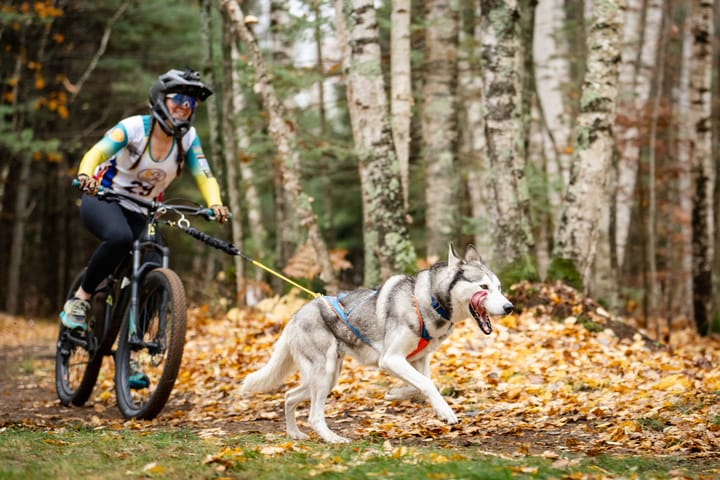
Canicross demands flawless synchronization between runner and dog, connected by a bungee line that transmits every shift in momentum, every tactical acceleration. The partnership must function as a single competitive unit. Krzemiński's consistency across both heats—separated by less than nine seconds—demonstrates the precision of that partnership under championship pressure.
What made this victory particularly significant was the step from national to global competition. Winning a world championship requires a different order of performance than domestic success. The pressure shifts. The competition deepens. The championship in Minoqua brought together the world's best canicross athletes from established sleddog nations, each believing they could claim the title.
Krzemiński's approach to the challenge was characteristically measured. Before the event, he described his objective as "being competitive with the best"—a statement that could be mistaken for modesty from a two-time national champion. The results prove it was something else: a clear-eyed assessment of what world championship performance requires. At this level, past success guarantees nothing.
The depth of the men's canicross field made the victory more impressive. Fourth-place finisher Olivier Gagnon of Canada (21:06.1) and fifth-place Brayan Esleyder Gutierrez Hortua of Colombia (21:21.5) both posted competitive times that would win most international races. Slovakia's Ján Mikuš, a proven competitor who finished second in the 5.0 KM Dog Bikejor event earlier in the championships, placed sixth in canicross at 21:51.1. Krzemiński didn't just win—he separated himself from a legitimately elite field.
The victory continues Poland's emergence as a force in international dryland sleddog sports. While traditional powerhouses like Norway, Canada, and the United States dominated many disciplines in Minoqua, Krzemiński's canicross gold—combined with Magdalena Krzeminska's seventh-place finish in women's dog bikejor—signals growing Polish competitive depth.
Just three weeks after his world championship triumph, Krzemiński returned to competition at the Polish National Championships. During that event, while defending his national title for the third consecutive year, his mother died in hospital. The emotional circumstances under which he secured that third Polish championship add a dimension of personal resilience that statistics cannot capture.
For Krzemiński, the Wisconsin championship represents the defining achievement of his competitive career. Representing the Polish Association of Sleddog Sports (PZSPZ) and competing for SC Hellhounds club, he proved that his two national titles were not the ceiling of his abilities but the foundation for something greater. His IFSS world championship gold, followed by a third consecutive national title won under unimaginable personal circumstances, establishes a standard of excellence and mental strength.
The question now is whether anyone in international canicross can challenge that standard. Based on the results from Minoqua, Krzemiński has announced his arrival at the top of the sport. In a discipline measured in seconds and tenths of seconds, a 28.8-second victory margin is a statement. The world's best came to Wisconsin. A Polish champion left as world champion.







Comments ()